Prefix (Basic ㊦ 233)
A prefix which means ‘every (unit of time)’.
Equivalent: Every; per
| Noun of time | 毎 | |
| 毎朝 | Every morning | |
| 毎月 | Every month |
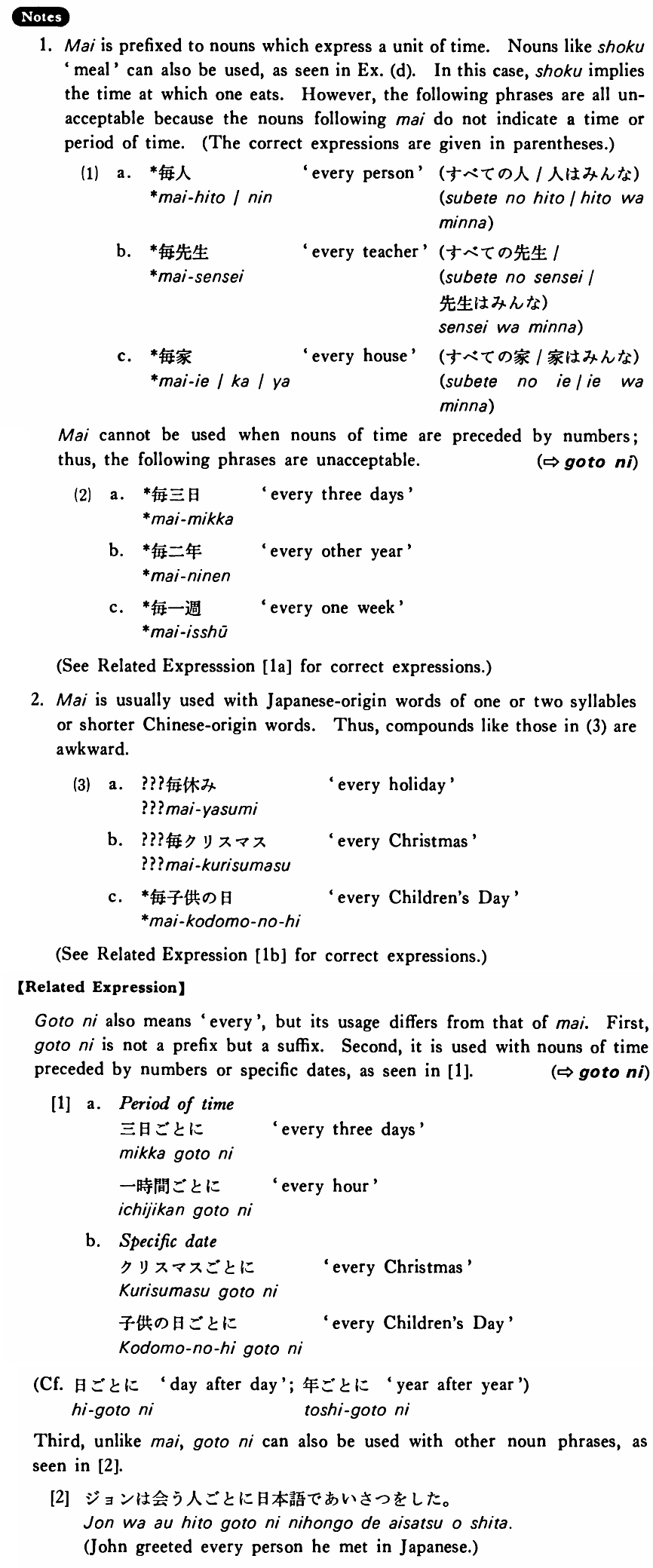
1. 毎 is prefixed to nouns which express a unit of time. Nouns like 食 'meal' can also be used, as seen in Example (d). In this case, 食 implies the time at which one eats. However, the following phrases are all unacceptable because the nouns following 毎 do not indicate a time or period of time. (The correct expressions are given in parentheses.)
| a. | *毎人 | every person | (すべての人 人はみんな) |
| b. | *毎先生 | every teacher | (すてべの先生 先生はみんな) |
| c. | *毎家 | every house | (すべての家 家はみんな) |
毎 cannot be used when nouns of time are preceded by numbers; thus, the following phrases are unacceptable.
(⇨ ごとに)
| a. | *毎三日 | every three days |
| b. | *毎二年 | every other year |
| c. | *毎一週 | every one week |
[See Related Expresssion [1a] for correct expressions.]
2. ごとに is usually used with Japanese-origin words of one or two syllables or shorter Chinese-origin words. Thus, compounds like those in (3) are awkward.
| a. | ???毎休み | every holiday |
| b. | ???毎クリスマス | every Christmas |
| c. | *毎子供の日 | every Children's Day |
[See Related Expression [1b] for correct expressions.]
【Related Expression】
ごとに also means 'every' but its usage differs from that of 毎. First, ごとに is not a prefix but a suffix. Second, it is used with nouns of time preceded by numbers or specific dates, as seen in [1].
(⇨ ごとに)
| a. | Period of time | |
| 三日ごとに | every three days | |
| 一時間ごとに | every hour | |
| b. | Specific date | |
| クリスマスごとに | every Christmas | |
| 子供の日ごとに | Every Children's Day |
(Complementiser phrase)
| 日ごとに | day after day; | 年ごとに | year after year |
Third, unlike 毎, ごとに can also be used with other noun phrases, as seen in [2].
[2]